Hookup and connection
Introduce the connection process and the safety checks involved in preparing the pickup and trailer combination before movement.

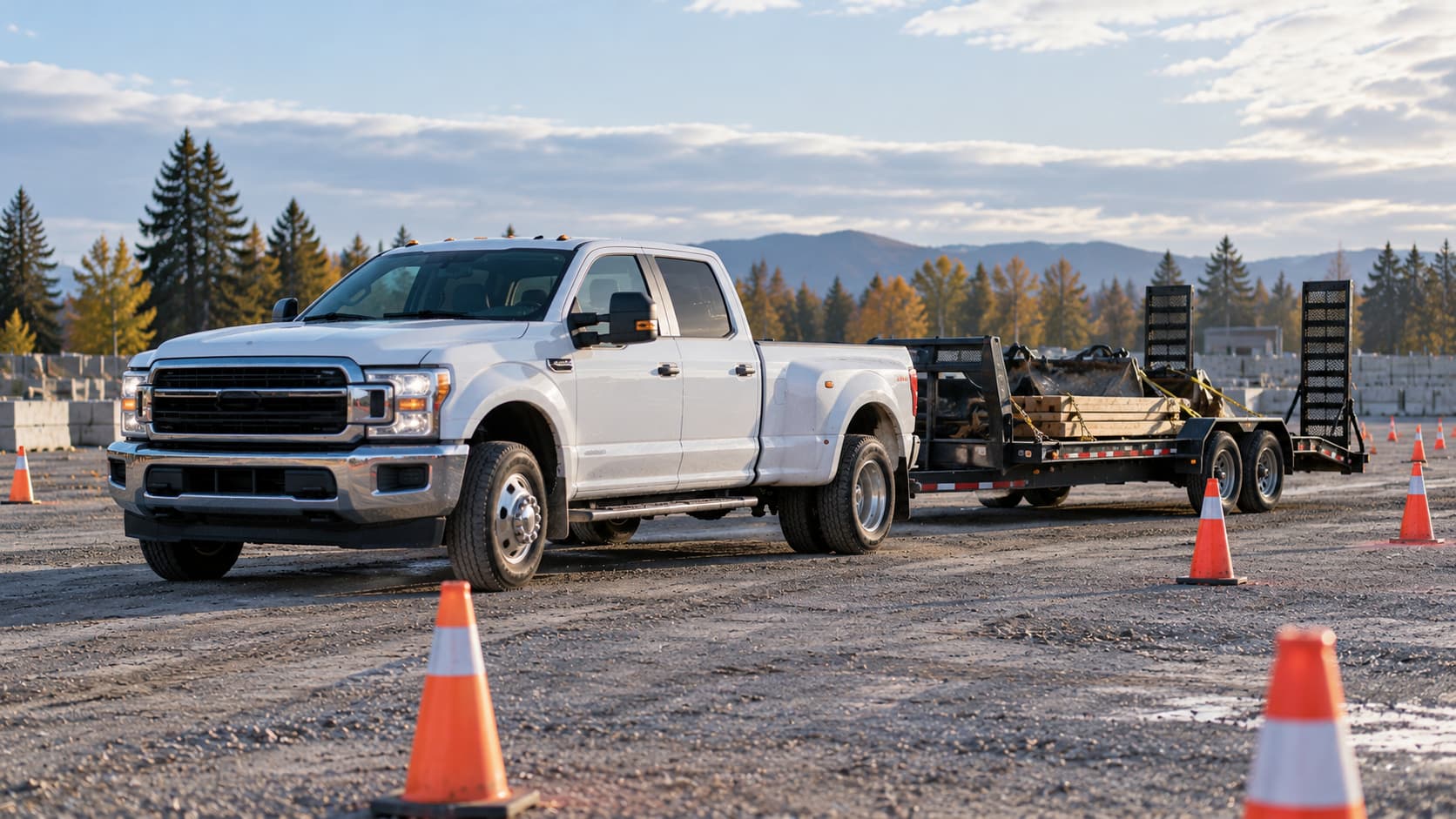
Pickup & utility trailer training
Start with the setup. Build control through practice.
Hands-on training that connects trailer preparation, purposeful inspections and practical manoeuvring through progressively challenging exercises.
Responsibility begins before movement
Trailer operation starts with preparation: connecting the equipment, considering the load and understanding what needs to be checked before departure.
Once moving, the driver needs to account for the trailer’s path and learn how observation and steering work together during backing.
This course introduces those responsibilities, then gives participants practical opportunities to build their understanding behind the wheel.
Before the wheels turn
A useful pre-trip depends on understanding what is being checked and what a concern means for the task ahead. Preparation receives focused attention before practical driving begins.
Introduce the connection process and the safety checks involved in preparing the pickup and trailer combination before movement.
Discuss loading and securement considerations in relation to the equipment and intended work, bringing attention to concerns that need to be resolved before departure.
Build an understanding of what the driver needs to check and why. Connect the inspection to the trailer, its connections and its readiness for the task.
Encourage drivers to recognize uncertainty, ask questions and address concerns before attempting a task beyond their current understanding or ability.
Three practical focuses
Backing asks the driver to coordinate movement and observation. These three focuses give participants a clear way to approach the practical learning.
Give yourself time to understand the movement.
Develop a deliberate approach to manoeuvring, with attention to pace, control and the opportunity to recognize when an adjustment is needed.
Connect the input to the trailer’s response.
Use practical exercises to understand the relationship between steering inputs, pickup movement and the changing position of the trailer.
Know where to look and what the view means.
Develop mirror use and observation skills that help the driver interpret trailer position, direction and available space.
Put understanding into motion
Participants work through practical challenges that connect the vehicle, trailer and surrounding space.
The learning includes forward movement, backing and the communication needed when working with a guide.
Bring attention to the path of the trailer through turns and the space the combination needs around nearby objects.
Practise coordinating observation and steering to understand and manage the trailer’s movement.
Discuss the guide’s role, communication and how the driver and guide work together during a manoeuvre.
Build the habit of recognizing uncertainty and seeking clarification or assistance when the task exceeds the driver’s current confidence or understanding.
Introduce it. Practise it. Build on it.
Practical exercises develop as participants gain understanding and control. Coaching helps them connect each attempt to the next adjustment.
Establish the purpose of the exercise and the concepts the participant will use.
Give the participant hands-on experience with the pickup and trailer, supported by coaching.
Progress the exercises as the learner develops, connecting earlier learning to more demanding positioning and backing tasks.
Bring the learning together in a final assessment, followed by the course certificate.
Small-group practical training
Each half-day session accommodates a maximum of three participants, supporting hands-on practice and individual coaching.
For a larger team, two separate sessions can accommodate up to six participants in one day.
Share details of the pickup, trailer and any available training space so we can confirm suitable arrangements.
Trailer training questions
The course is intended for employees who tow utility trailers with pickups, including drivers with limited trailer experience and those who want to strengthen their setup, observation and backing skills.
Training is delivered in half-day sessions for a maximum of three participants. Two separate sessions can accommodate up to six participants in one day.
Yes. Setup is a central part of the training, including hookup, loading considerations and purposeful pre-trip checks before the vehicle moves.
Yes. The course emphasizes hands-on practice, with progressive challenges built around Speed, Steering and Sight.
These are the three practical focuses of the backing instruction: managing the pace of the manoeuvre, understanding steering and trailer response, and using observation to interpret position and space.
Yes. The training includes working with a guide, with attention to the role and communication involved in supporting a manoeuvre.
Yes. Topics are introduced before practice, and exercises progress as the learner develops. Let us know about participants’ experience when arranging the course.
Yes. The course includes a final assessment and a certificate.
Contact us with details of your pickup, trailer and any available training space so we can confirm equipment suitability and location arrangements before booking.
Prepare the people towing on your behalf
Tell us about your pickup and trailer, your participants’ experience and the tasks they need to perform. We’ll discuss the training arrangements.