Seating and mirror setup
Connect the driver’s position and mirror setup to the information available around the vehicle. Build an understanding of what can be seen and what still needs attention.

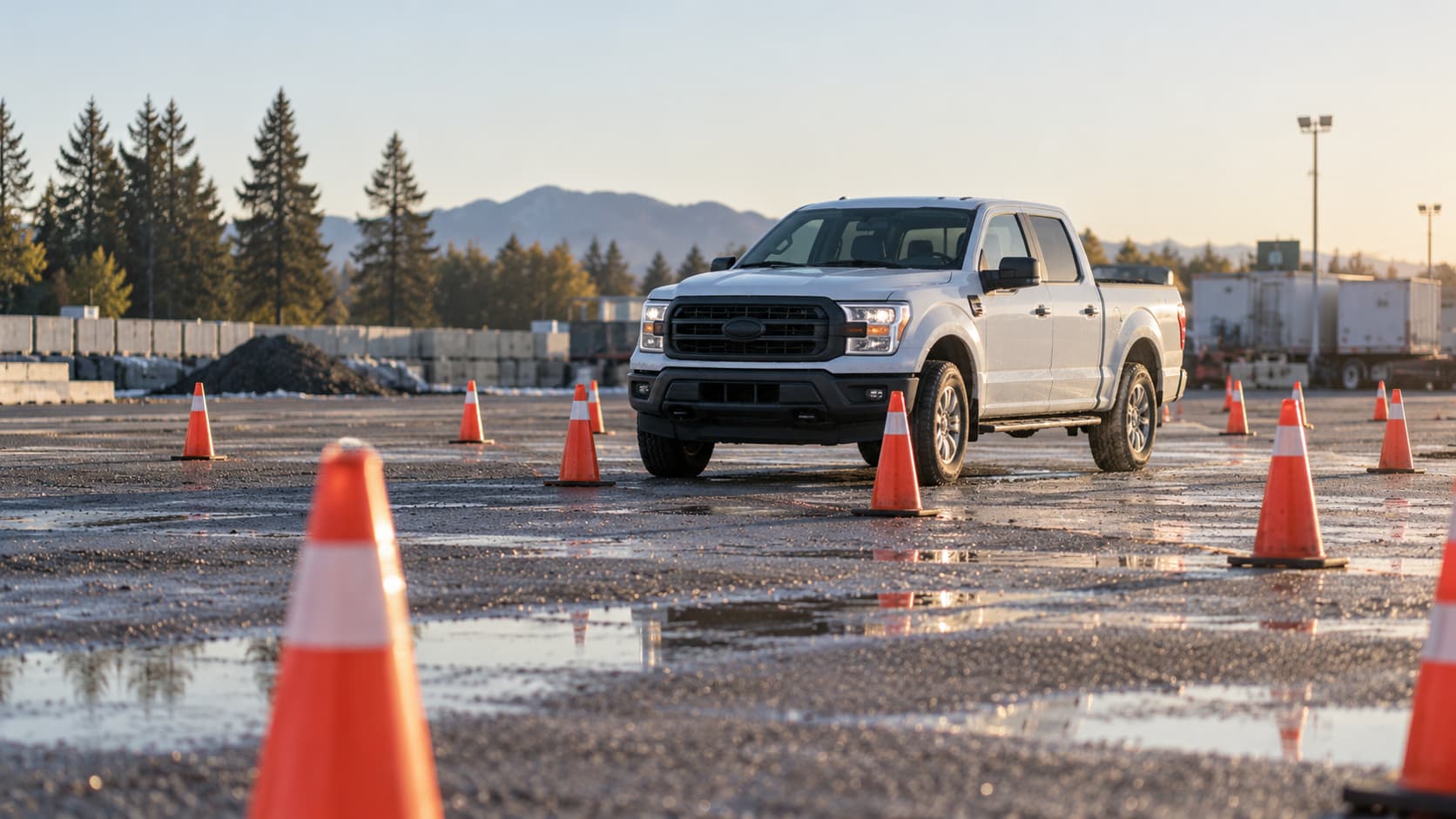
Hands-on training · Closed-course learning
Understand the space. Know the movement. Build the control.
Practical backing, parking and manoeuvring training that helps drivers connect what they see with how their vehicle moves.
Make vehicle movement make sense
Drivers also need to understand where the vehicle is, how it will move and what needs attention along the way.
Mirror setup, observation, pivot points, front-end swing and off-tracking all contribute to that understanding. When those connections are unclear, tight spaces become harder to judge.
This course brings those concepts into the vehicle, giving participants practical opportunities to see, experience and understand the movement.
The understanding behind the control
Connect the driver’s position and mirror setup to the information available around the vehicle. Build an understanding of what can be seen and what still needs attention.
Develop a more deliberate approach to where to look, when to look and how to interpret the space around the vehicle.
Relate what the driver sees from the seat to the vehicle’s position, its boundaries and the objects around it.
Explore how the vehicle changes position through a manoeuvre and why understanding its movement matters in confined spaces.
Bring attention to the movement of the front of the vehicle during manoeuvres, alongside the area the driver is trying to enter.
Understand how different parts of the vehicle follow different paths through a turn, and connect that understanding to clearance around obstacles.
Learn behind the wheel
A varied course layout keeps participants engaged as they move through progressively demanding exercises.
With a maximum of three participants per half-day session, the course emphasizes time behind the wheel, coaching and opportunities to apply adjustments.
New drivers build foundations. Experienced drivers have an opportunity to examine habits and refine skills through exercises that demand attention and precision.
Begin with vehicle setup, observation and an understanding of the space the driver needs to manage.
Use practical exercises to relate reference points, steering inputs and the vehicle’s changing position.
Apply the learning to increasingly demanding backing, parking and positioning exercises.
Complete the final assessment, bringing the observation, awareness and vehicle-control skills together.
Who the training is for
Build a practical foundation for understanding vehicle movement and managing space.
Challenge established habits and refine awareness through progressively demanding exercises.
Develop familiarity with the position, visibility and movement of the vehicle they are expected to operate.
Give backing, parking and low-speed positioning the focused practice they deserve.
Plan the training day
3
Book one session for up to three participants, or arrange two sessions to accommodate up to six participants in one day.
Two separate sessions keep each group within the three-participant maximum.
Location requirement
Your organization can provide a training location, or we can help identify one. The space must be suitable for the vehicles and planned exercises.
Tell us about the vehicles and any available site when booking so we can confirm the arrangements.
Assessment-based certification
The course concludes with a final assessment used for certification. Participants bring together the observation, spatial awareness and vehicle-control skills developed during the session.
Certification is based on the assessment, rather than attendance alone.
Practical training questions
The course is a half-day session for up to three participants. Two sessions can accommodate up to six participants in one day.
Yes. The course emphasizes practical, behind-the-wheel learning through progressive exercises in a closed training area.
The course develops observation, mirror and seating setup, reference points, spatial judgment, pivot-point awareness, front-end swing and off-tracking awareness through backing, parking and tight manoeuvring exercises.
Yes. The exercise progression is designed to engage and challenge both new and experienced drivers. Experienced operators have an opportunity to examine habits and refine their control.
A suitable closed-course location is required. Your organization can provide one, or Advance Driver Safety can help identify a location. Site suitability and arrangements are confirmed before training.
Tell us about the vehicles your employees operate when arranging the course so we can confirm suitability and training arrangements.
Yes. A final assessment is used for certification. Certification is based on the assessment rather than attendance alone.
Exercises progress from foundational observation and vehicle awareness to more demanding manoeuvres. Participants have opportunities to practise, receive coaching and apply adjustments before the final assessment.
Yes. Up to six participants can be accommodated across two separate half-day sessions, with a maximum of three participants in each session.
Give low-speed driving focused attention
Tell us about your vehicles, participant numbers and training location. We’ll discuss a half-day session or a full day with two separate groups.